Science based learning
Let us tell you a story
Chinese Character Knowledge Footprint
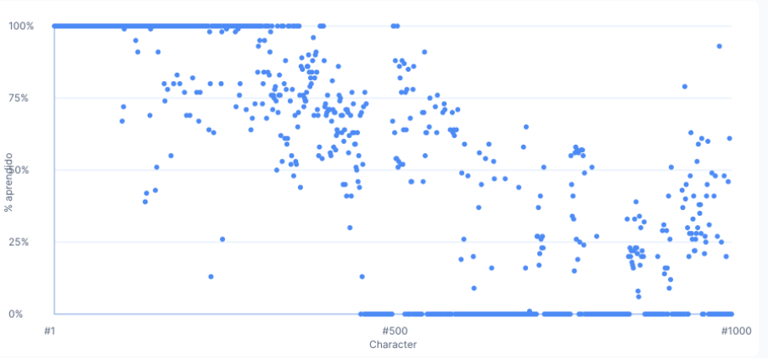
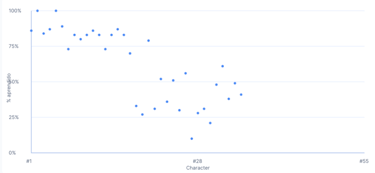
The Chinese Character Knowledge Footprint is a visual model developed at Harvard University by Dr. David García Lou to represent an individual’s knowledge Chinese in a precise, intuitive way.
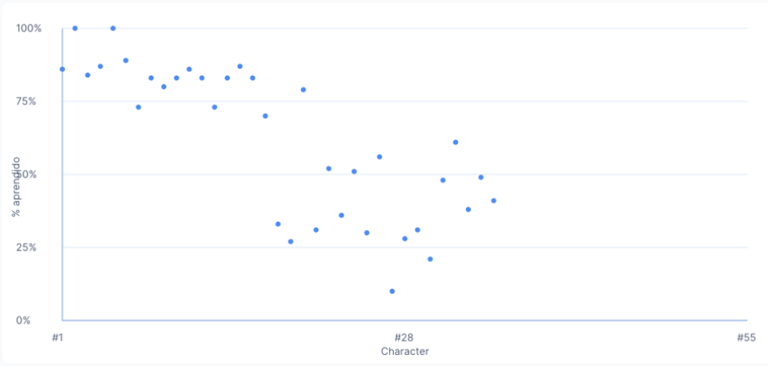
Each dot in the footprint corresponds to a single Chinese character. The horizontal axis follows a fixed order of characters—such as the frequency-based sequence used in the Chinese Character Tracker—while the vertical axis represents the degree of mastery of that character, expressed as a percentage. High positions indicate strong knowledge and recall; lower positions reveal partial familiarity or lack of mastery.
What makes this footprint powerful is its consistency. Regardless of whether the learner is a beginner, intermediate, or advanced student, the overall shape of the distribution remains stable and interpretable. Beginners show dense knowledge at the earliest characters with rapid drop-off, while advanced learners display broader coverage with nuanced variation across thousands of characters. In this sense, the footprint acts as a reliable proxy for real Chinese literacy.
The precise valuation of each character’s knowledge can be computed in different ways—through recognition tests, recall accuracy, spaced-repetition performance, or usage data. Tools like the Chinese Character Tracker provide a structured and reproducible way to generate these measurements, but the framework itself is method-agnostic.
Beyond assessment, the Chinese Character Knowledge Footprint is a diagnostic instrument. It highlights gaps, plateaus, and inefficiencies in learning, allowing learners, teachers, and researchers to move from vague proficiency labels to concrete, data-driven insight. Instead of asking “How good is your Chinese?”, the footprint shows exactly what you know—and what you don’t—character by character.
Statistics
When you learn a Western language, you start with the alphabet. “a, b, c, d… x, y, z.” Twenty-four or so letters. There’s no debate about which one you should learn first. You simply learn all of them, and from that point on you start building syllables, words, and eventually whole ideas. The system is fixed, and the order doesn’t matter.
Chinese is different.
If we say, for simplicity, that Chinese has 10,000 “letters,” the question becomes unavoidable: which ones should you learn first?
Most textbooks solve this by offering common words, simple characters, and useful expressions. It’s a good approach. But a scientist might ask: is there a statistically better way?
Lou Dawei—a Spanish doctor who spent six years learning Chinese—asked exactly that. In the beginning he applied the same survival technique used in medical school, where thousands of pages must be absorbed every semester: prioritize the most common first. But this time he wasn’t memorizing anatomy—he was facing a sea of characters.
As a scientist, he suspected there was a mathematical answer hiding behind the chaos.
So in 2010, with a few friends at the Instituto Cervantes of Shanghai, he assembled a corpus of a thousand newspapers and books. Then they asked a simple, beautiful question:
“If you had to compete with a friend to recognize Chinese characters, and you were allowed to learn only one new character today, which one would give you the biggest advantage?”
In other words:
What is the single most common Chinese character in real text?
And after learning that one, what’s the second most valuable?
And the third?
By sorting the entire corpus by frequency, they created a ranking that answered the problem with mathematical precision:
if you want to maximize how much of any text you can understand tomorrow, learn the most frequent character today, then the second, then the third… and keep going.
This simple insight—clear, scientific, almost playful—became a compass.
Following it day after day, Lou Dawei reached around 4,000 characters, not by brute force, but by statistical elegance.
Chinese Character Tracker is built on that same idea:
Learn smarter, not harder.
Let the language reveal its structure through frequency, and let your journey become a sequence of meaningful, optimized steps.
On the other side, learning a language is never purely mathematical. Frequency gives you direction, but memory follows its own rules. Some characters simply refuse to stick, no matter how common they are. You revisit them again and again, and they still slip away. And then, strangely, you might meet a rare character—something you almost never see—and for some reason it stays with you. A joke, a street sign, a dish on a menu, a moment with a friend… and suddenly that character becomes unforgettable.
Human memory has its own physics.
Because of that, there has to be a place to keep those “unexpected victories”—the characters you learned effortlessly, the small treasures you find along the way. A space where each of them can live, ready for you to revisit, reinforce, and enjoy. Almost like a personal Chinese chest, a box of characters you’ve claimed as yours, not because they’re common, but because they clicked.
Chinese Character Tracker gives you that space.
It honors both sides of the journey:
the science that guides you forward,
and the unpredictable magic of the characters that choose you first.


Characters are little individuals that travel with you on your learning journey.
That’s why the notes for each character in the app are kept in a chat-like interface. Learning a character has something magically similar to meeting a new person. You see their face, you shake hands, you try to catch their name… and somehow you get it slightly wrong. Their face feels familiar because—they tell you later—they play football on the same team as your brother.
Next time you meet them, you remember the football connection perfectly, but you still have to ask for their name again.
Chinese characters behave the same way.
You might meet 大 and remember the shape instantly. You know it means “big,” but for some reason the pronunciation escapes you. Or sometimes, the opposite happens: you recognize the name because you’ve heard it in conversations, but you can’t quite recall the shape.
Then one day, it clicks. You learn that his name is dà. But later in a hospital setting you hear someone call him dài. Just like people, characters change a bit depending on where they are and what they’re doing.
And sometimes you don’t remember anything about a person except one detail: where you met them.
Characters are the same. Maybe you don’t recall its pronunciation or meaning, but you remember exactly when a friend wrote it in your notebook while telling you an unforgettable story. Those associations stay.
Now imagine the miracle of human memory:
you can remember thousands of people — their names, jobs, hobbies, fragments of stories — because each memory is tied to tiny connections, subtle pieces of context that anchor them in your mind.
We already do this naturally with friends, classmates, colleagues… and even the half-strangers who live in our WhatsApp list. Sometimes you scroll through a chat just to remember who someone was and what you talked about. And suddenly, two or three memories return.
Chinese Character Tracker uses the same principle.
Each character gets its own “chat,” a living record where you can store all the little fragments that make it yours: a photo of the blackboard when your teacher wrote it perfectly, the menu where you first saw it in your favorite restaurant, the voice note of a friend helping you pronounce it, the story that made it stick.
Because learning characters isn’t memorization —
it’s building relationships.
One little individual at a time.


Why self-evaluation and tracking
Everyone knows how hard it is to stay motivated when learning Chinese.
It’s a long road, full of characters that disappear as easily as they appear, full of good days and days when you feel you’re walking in circles. Tracking your knowledge changes that.
Self-reporting with sliders is based on the same idea as the Visual Analog Scale used in medicine — a method backed by decades of research showing that people can accurately express complex internal states through a simple continuum. While you study a list, you can update how you actually feel about your knowledge. Some days you’re confident. Other days you’re not. The sliders let you capture that feeling in a simple, intuitive way.
And it works beautifully for Chinese characters, especially if your goal is big:
1,000 characters, 5,000, or more.
Whether you want to recognize them, read them, or even write them.
You’re not competing with anyone — you’re competing with yourself.
As you use the sliders honestly, something subtle happens: you start to see progress you couldn’t feel before. Real-time statistics show you which characters you haven’t reviewed in a long time, which ones feel uncomfortable, and which ones have become solid. Instead of being lost in a giant forest of symbols, you have a map — a dynamic map of your own brain.
Chinese Character Tracker wasn’t designed to replace your learning method.
It was designed to support it.
You can keep using your favorite textbook, app, teacher, flashcards, or audio courses — and use the tracker as the layer that tells you where you stand. At any moment, with a single glance, you know:
How many Chinese characters you truly know.
How they’re evolving.
Where your strengths are.
And where your next step should be.
Learning Chinese becomes less of a fog and more of a journey you can finally see — a journey anchored in honesty, data, and self-understanding.